
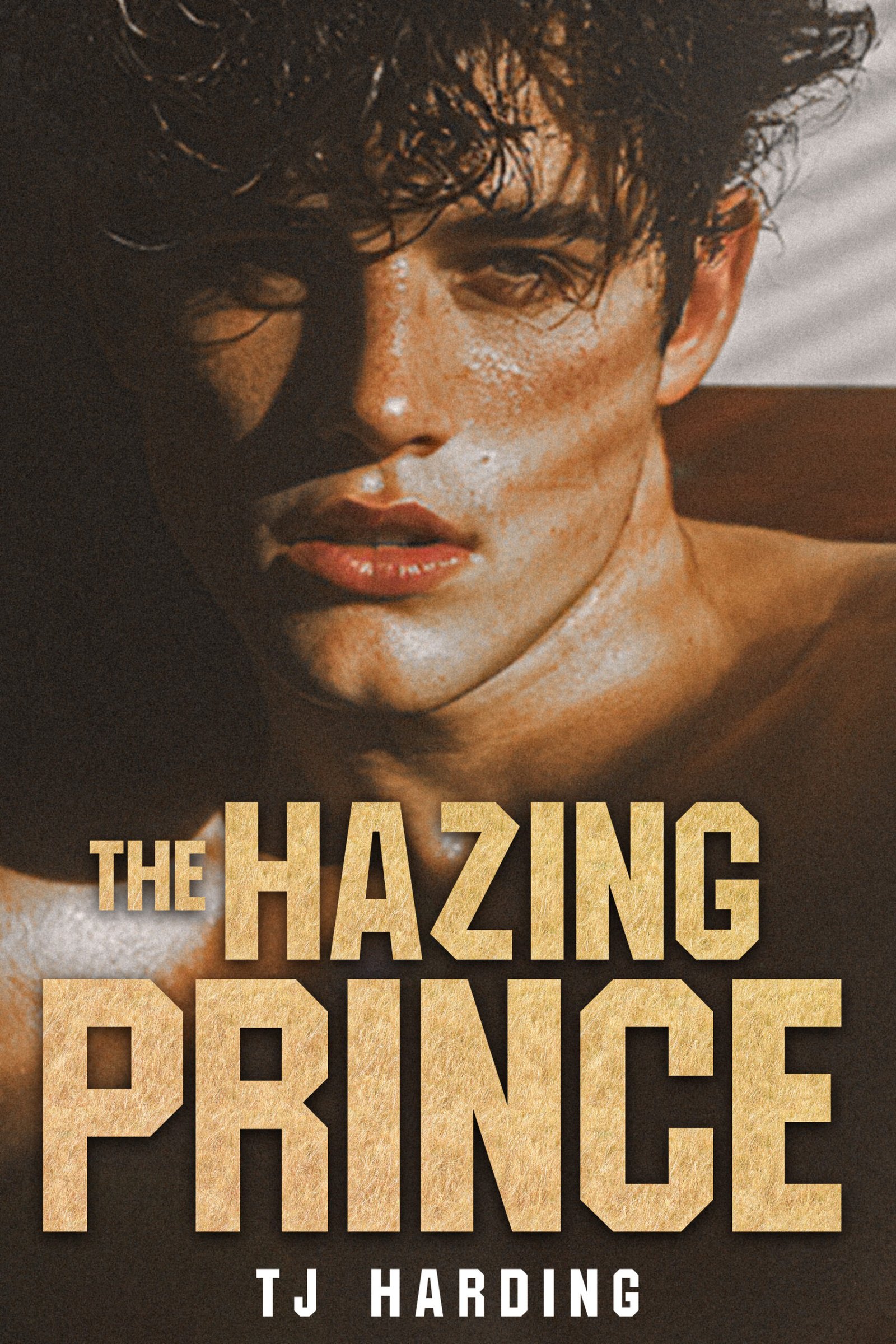
The Hazing Prince
A Gay College Romance
To keep my scholarship, I must belong to him.
- Published
- October 6, 2026
- Length
- 360 pages
- Point of view
- Dual POV, first person
- Ending
- HEA
- Heat
Free to read with Kindle Unlimited
About the book
I came here to study. I stayed to serve him.
My only chance to escape poverty and study law is the Cavendish scholarship, but it comes with strings attached. I must join a fraternity in order to build lasting bonds with New York’s most notorious trust-fund kids.
What isn’t in the small print is a hazing challenge that puts me in complete and total service of Everett Cavendish himself for a whole month.
I am his toy.
I am his to command.
I can’t say no to him.
Walking away from the challenge means walking away from Kappa Gamma Phi. And from the generous scholarship his family doles out.
But Everett’s idea of owning a freshman is confusing and complicated. He wants me, but he doesn’t claim me. He humiliates me, but he protects me. He gets into fights over me, then sends me away so he can be with his girlfriend.
Until I discover his weakness.
He can play a straight hotshot all he likes. But when I give him that thirsty look of mine, he caves in a heartbeat. And if there’s one thing I’m good at, it’s looking at Everett Cavendish like I want him.
This game has just become a lot more dangerous.
THE HAZING PRINCE is an M/M college romance depicting a dangerous attraction, an arranged ‘relationship’, forced proximity, and raw obsession. It’s a standalone novel. Before reading, see the content warnings inside the book.
Show content notes
This book includes:
- See inside the Book
Read the first chapter
The socks are gray with a red band at the top, and they are not mine.
He threw them at me on the second morning while I was getting my shoes on. Didn’t explain, didn’t look up from his phone. Just a pair of socks across the room, underhand, and I put them on.
They’re too big, and soft from years in the wash, and they’ve got somebody else’s name tape sewn inside the cuff, E. CAVENDISH, in a school font, from an age when a woman he pays or a woman who loves him sewed his name into his clothes.
Nobody can see them. I’ve got jeans on over them. I sat through two hours of torts that morning with my ankles crossed under the desk, and there wasn’t anybody in that room who knew, and I thought about them all day anyway, which I assume is the point, and which I’d assume he knows.
The pillow’s his too. Somebody had made the mattress up before I got there that first night, sheets and all, and made it badly: by the morning the fitted sheet had come off at one corner. Nobody in that house makes a bed for anybody. When it got light I saw that his bed had one pillow on it, and the case on mine matched his.
He made my bed, and then he told me I was nothing. I fixed the corner before he woke up, and neither of us has said a word about it.
The coffee takes three days to work out.
He wouldn’t tell me. That was a choice he made in front of me on the first night, and I’ve been paying for it since. The first morning I brought it black, because he looks like a man who drinks it black, and he took it and said nothing and drank half. The second morning I brought it with milk, because nothing isn’t the same as approval, and he took it and said nothing and drank half.
On the third morning I’m in the kitchen at five thirty, and he comes down for a glass of water before I’ve gone up, and he doesn’t know I’m behind the pantry door with the filters. He stands at the machine on the counter, the one he told me never to use, and pours himself an inch of it, and puts in three sugars.
Three. Stirs it with the end of a pen. Drinks it standing up in the dark like a man doing something in a bathroom stall.
I stay behind the door until he’s gone, with the filters crushed in my fist. For two days I’d been bringing a man his coffee and getting it wrong, and the answer was a thing he does when he thinks the room is empty.
I bring it up that morning with three sugars in it. He takes the lid off, looks at it, puts the lid back on, and drinks the whole thing.
He still says nothing. He hasn’t thanked me once, not on any morning, and I didn’t expect him to. What I didn’t expect is that getting it right would feel like anything. It feels like a raise.
The gear is worse, because the gear he teaches me himself.
He does it once, on Wednesday evening, on the floor of the room with everything laid out in a line, and he teaches it like a man letting somebody hold a thing of his for the first time. Unisuit folded in half and not rolled. Socks on top of it. Shoes underneath with the heels to the wall. Water bottle filled the night before and left out of the bag, because it sweats. Tape, if he’s blistered, which he is. Heart-rate strap last and on top, always on top, never in the side pocket.
“Why not the side pocket?” I say.
“Because it isn’t,” he says.
I let it go, and I lay it out that way the next night, and the night after, and within the week I’ve worked out that not one single element of that order makes any difference to anything, which leaves superstition. Twenty-one years old, and he can’t get into a boat unless a rubber strap is sitting on top of a folded suit in the correct position, and he’d rather be obeyed than explain that to anybody.
I don’t say so. I file it with the sugar.
Once, while I’m getting the shoes the right way around, he crouches to move the bottle, and our hands go over each other on the floor.
It’s nothing. It’s the back of his hand against mine, and we both keep going, and he moves the bottle a few inches to a place that is no better than where it was, and I go on with the shoes, and put the left one where the right one goes, and have to do it again.
By the end of the week, the dawns are the problem.
The boathouse is up past the bridge where the river narrows, and at that hour in September the water is flat and the color of the underside of something, and there’s mist coming off it in a layer, so the shells sit in it and the hulls disappear and eight men come up the river apparently sitting on cloud, which is ridiculous, and I resent it.
My job is to be on the bank with a bag and a stopwatch I’m not authorized to start.
And I watch him work. Nobody warned me about him on the water. On the lawn he’s a person being looked at, and in the house he’s a person being obeyed, and on the water he’s neither. He’s just extremely good at something difficult, and it changes his voice. It goes lower and it goes flat and it carries in a way I don’t understand the physics of. Down two on the rate. Bow four, you’re early. Again. Better. Hold it there, hold it, that’s the one.
Eight men in one long, thin boat, and when he gets it right they stop being eight men. The blades come out together and go in together and the whole thing lifts and runs between strokes, and it goes quiet, and the only sound off the river is the water under the bow.
So now I know what the shoulders are for.
When they come in, he’s up on the dock with his hands on the gunwale, taking the weight while the crew climbs out, and his forearms are doing what forearms do under load, and the veins stand up, and I’m looking at that instead of at the boat, and I’m furious with myself about it all morning.
The bathroom is off the room itself, which I didn’t know until the first morning.
The good room on the second floor comes with one. A door in the corner that I’d taken for a closet, and behind it a bathroom the size of a phone booth, a sink, a mirror, a shower with a curtain, and a bulb that takes a moment to think about it before it comes on.
One door. His room, his bathroom, and me on the floor in between.
He doesn’t close it. Not properly, not ever. It swings to, and the latch doesn’t catch unless somebody pushes it, and he has never pushed it, because he has never in his life had to think about who might be on the other side of a door.
Thursday morning I’m on my knees on the rug, packing his kit into the bag in the order that doesn’t matter, and the door is standing open, and he’s shaving.
He’s got a towel around his hips and nothing else. There’s still water on him from the shower, across his shoulders and down the middle of his back, and it moves while I’m looking at it, one line of it running down the groove of his spine and into the towel, and I’ve stopped packing anything. I’m kneeling on a rug with his unisuit in both hands, watching water move on a man’s back.
His chin’s up and turned away, and he’s working the blade down the side of his throat in short strokes. Every time his arm goes up, the whole shoulder goes with it, the muscle sliding under the skin like something turning over. I can see the shape of his ribs when he stretches. I can see the two lines that come down off his hips and disappear into the towel, and the towel is not tied especially well, and he doesn’t touch it.
He starts talking to me about the regatta.
I can’t forgive him that. He talks. He stands there with nothing on and a razor in his hand and tells me the entries for the regatta have gone up and he’s got two novices in the boat and he isn’t happy about it, and then he asks me what I’ve got today, and waits, and I have to produce an answer, out loud, in a voice.
“Nine o’clock, then the library,” I say.
“Sounds thrilling.”
“It’s torts.”
“Christ,” he says, and grins at himself in the mirror, and goes back to his throat.
And I’m hard.
I’m on my knees on a Persian rug holding a man’s kit and I’m hard in my shorts like I’m fourteen, and there is nothing to be done about it, and if he turns around he will see it, and he will see it instantly.
So I sit back on my heels and put the bag on my lap and keep talking about torts.
Great. Fucking excellent. This is going well.
He isn’t doing it on purpose, and I can’t stand that. If he were doing it on purpose I’d know what it was and I’d know what he was, and I’d have something to be angry about, and anger I can use. But he isn’t. He stands there in a towel because it’s his room. He talks to me while he does it because I’m in it, and people like him talk to whoever’s in the room.
He does not care whether I see him. Not one way and not the other. There’s nothing in it at all. He has had a body that people look at since he was about fifteen, and he stopped noticing it was happening years ago, and he’d no more cover himself in front of me than he’d cover the desk.
And I’m the one on the floor with a bag on my lap.
I’ve known I’m gay since I was twelve, and I’ve never been ashamed of it. Not for an hour, not in Waterbury, not in this house.
Whatever this is, it isn’t shame. I don’t have a name for it, and I don’t want one, because the name would have his name in it.
He rinses the razor and taps it twice on the edge of the sink.
“You’ll want a coat,” he says. “It’s cold by the water.”
“Yes, Sir,” I say.
My voice comes out completely normal, which is the only thing that’s gone right all morning.
On Friday night he calls at two in the morning.
I’m asleep on the mattress. The room’s empty. He went out with Porter after dinner and hasn’t come back, and the phone goes off on the floor by my head, and the screen says CAVENDISH.
“Where are you?” I say.
He names a bar on Amsterdam, four blocks down.
I put shoes on over the socks and walk it. It’s mild out, and the street’s still got people on it, the late kind, and when I get there he’s outside on the sidewalk with Porter and two others. The first thing I check is whether he’s drunk. He isn’t. He’s had some, but he’s upright and clear.
“Sir,” I say.
Porter thinks this is the funniest thing that has ever happened in the history of New York.
Everett doesn’t. He looks at me standing on the sidewalk in a T-shirt at that hour, and he keeps on looking after Porter has run out of laugh, and then he says, “Give me a minute,” and turns back to them.
So I stand there for about the length of a cigarette, which is what one of the others is doing. Nobody wants anything from me. The conversation is about somebody’s brother’s boat, and I’m on the edge of it with my hands in my pockets, being present, which seems to be the job.
When he’s done, he says good night to them, and we walk home.
We don’t talk. Four blocks, and he’s half a step ahead the whole way because his legs are longer, and at the crosswalk on 118th he stops for a light that nobody in this city stops for and waits for it to change, and we cross on the green like two people in a pedestrian safety video.
At the door of the house he says, “Thanks for coming.”
Which is the first thing resembling a thank-you all week, and it isn’t for the coffee, and it isn’t for the gear, and it isn’t for standing on a bank in the cold with his bag. It’s for standing on a sidewalk doing nothing.
He didn’t need anything at that bar. He wanted me awake. I don’t know what to do with that.
Andrew finished his challenge on Wednesday.
He got up onto the roof of a seven-story building on Broadway through a stairwell door that somebody had propped open with a fire extinguisher, and there’s a photograph of his entire delighted face with the water towers behind him, and Porter has printed it and put it up on the bulletin board in the hall.
He finds me in the diner on Sunday, and he doesn’t ask how it’s going. He waits until I’ve got food in front of me and then says, “You’ve been doing this a week.”
“It’s fine,” I say.
“Jack. You got up at five thirty every day this week.”
“I’d have gotten up at five thirty anyway. I’ve got a nine o’clock.”
“You went and stood outside a bar at two in the morning.”
I look at him. “Who told you that?”
“Everyone told me that,” Andrew says. “Everyone in that house is telling everybody about it. It’s the funniest thing they’ve ever heard.” He leans back in the booth. “That’s not what I care about. What I care about is that you called him Sir on a public street, and walked home with him, and you’re sitting here telling me it’s fine.”
“It’s twenty-three more days,” I say.
“That’s not an answer. That’s a countdown.”
“It’s under control.”
He drops it, and I eat my eggs, and I don’t think either of us believes me.
On Monday he asks for the water bottle.
He’s at the desk, and he doesn’t look up, and he says, “Bottle.”
It’s on the shelf by the window, a few steps from where I’m standing, and I know exactly where it is because I filled it last night and put it there.
And I don’t move.
It isn’t a plan. A plan would mean I understood what I was doing. I just stand there for a moment longer than the thing requires, looking at the shelf, with my hands at my sides, and then I go and get it and put it on the desk.
He notices.
His head comes up, and he looks at me, and says nothing, about the bottle or anything else, and the look goes on too long.
He takes the bottle and goes back to the case, and I go back to the kit, and my heart is going like I’ve run up the stairs.
Get my updates
Join the newsletter and I’ll send you exclusive updates. Get ready for: release news, cover reveals and the occasional deleted scene. No spam, and you can leave any time.